How to Read a Stanley Stud Finder
How To Use A Stanley Stud Finder (Find Out Now!)
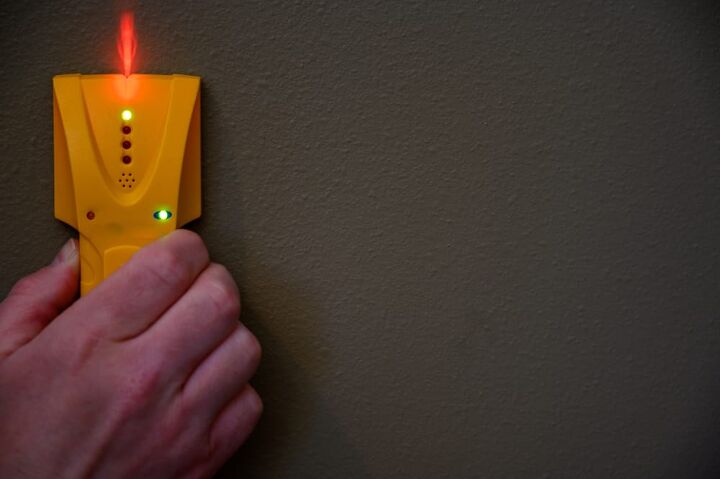
Stanley is one of the nearly recognizable brands when it comes to power tools and accessories. They make just about everything under the sun, making information technology possible for craftsmen to accept an entire workbench total of Stanley.
Stanley also makes stud finders, which are the key to remodeling jobs and will come in quite handy for fifty-fifty the smallest jobs. Using it is as elementary every bit managing a few buttons and watching for the carmine light to point that yous are nigh a stud. It is a simple however effective tool that can take on a huge array of tasks around the home or construction site .
Do You Demand Handyman Services?
Get free, zero-commitment quotes from pro contractors nearly yous.

Finding Studs
Studs offering structural strength . They are the backbone behind the drywall that allows for heavy anchoring. Before y'all tin can start hammering into a wall, you need to first know where the studs are located.
The old school way involved tapping the walls and carefully listening. But now, in that location are electronic stud finders like the Stanley Stud Sensor that make information technology super like shooting fish in a barrel to find studs . Moreover, these devices tin can be accurate up to about 3mm or so.
Step 1: Turn it On
Tin't expect it to work if y'all don't turn the device on, correct? For the well-nigh office, Stanley stud finders require a 9-volt battery to supply power . Check to make sure that the battery is seated properly to ensure that information technology works.
Turn the unit on. When it is started properly, there will be a green indicator calorie-free that pops up. This lets you know that it is ready to become. If your stud finder doesn't display the dark-green light and the batteries are in place, it could exist indicative of malfunction.
Stride 2: Place it on the Wall
Next, place the stud finder up confronting the wall that you program to work on. Make sure that you hold the stud finder at the summit that you are planning to smash or drill into the wall. Try to make it every bit comfy every bit possible so that you can drill or hammer as straight as possible.
There are some studs that jog or slant. When this happens, it can throw off calculations unless y'all happen to be at the exact height. Know ahead of time what kind of studs you are dealing with to make the procedure merely a little bit easier .
Step three: Positioning the Stud Finder
Slowly slide the Stanley stud finder across your wall. Commencement by moving horizontally as you get. In that location are red lights on the unit. These are meant to indicate the depth of the wall as you drag over the various pieces of the wall.
When the red light finally lights up, terminate moving. This is an indication that yous are approaching the location of a stud. When you lot are close, slowly move the stud finder dorsum and forth until yous are able to locate the stud. At this point, virtually of the lights should exist on by at present. Depending on your model, in that location may also exist a tone of some sort that indicates that the stud has been located .
Footstep 4: Mark the Spot
This is the easy part. Now that your Stanley stud sensor has located the stud, simply mark off the spot using a pencil. You desire to use a pencil for two reasons. Kickoff, it erases. Yous tin can make little marks here and there and but get rid of them later on.
The second is to remind yourself where to drill or nail. Even if you just had the stud finder up, it is easy to lose track of the verbal location. Save yourself the trouble and mark all of these spots using a pencil and eraser.
What Do the Lights Hateful on a Stanley Stud Finder?
For those who have non used a stud finder before, the dissimilar lights can exist initially confusing. Only in one case you know what each of them means, you can use them to quickly identify what is happening every bit y'all are locating a stud.
The carmine light is used to indicate wall depth . On some models, yous may see "AC" lit upward. That Air conditioning detection is meant to place any potential alive wires backside the wall. The AC detection can pick upwards wires that are up to 2" deep.
Beeps and sequential LEDs. When your stud finder starts to beep or wink in some kind of sequence, that indicates a reading. Depending on your model, there may fifty-fifty be a marking channel that makes marking the surface quick, authentic, and easy.
What Practice I Do if I Don't Have a Stud Finder?
Stud finders accept made information technology easier than e'er before to locate structural support backside walls. Though the process wasn't exactly rocket science, it did get out questions about accuracy. Stud finders have since removed those questions.
But what do you do if y'all don't have admission to a stud finder? Thankfully, there are a couple of common solutions that you can implement to get the job done. Keep in heed that a stud finder will always exist the quickest and easiest manner, so make sure y'all have yours on yous whenever yous tackle a chore.
Using Magnets to Observe Studs
While this might seem like a bit of an odd method, it has been proven to work. All yous need is a magnet and a little chip of tape or string to go the task done. Beginning out by taping or tying the cord to the magnet so that you can elevate it.
Put the magnet against the wall and slowly drag information technology until you experience information technology stick to the surface of the wall. More often than not, that will signal where your stud is. Keep in mind that the stronger the magnet, the easier fourth dimension you will have locating the studs.
Look at the Trim to Find Studs
What you lot may not have realized is that each of the baseboards in your home are connected to those studs that you are looking for . And so, it only makes sense to bank check out the baseboards for an indication every bit to the location of the studs.
Bank check out the baseboards to see if you tin see where they may take gotten nailed. Those modest holes, called dimples, mostly become filled with caulk or painted over. Nonetheless, you might exist able to see one of them, giving away the location of the stud. When you notice one of these pocket-size holes, measure out out in 16" allotments to find the location of any additional studs.
Measure from the Corner to Find Studs
Here'southward a good rule of thumb to consider: studs are typically about 16" on middle . And so, knowing that, you lot can perform calculations on where the other studs are by measuring out the corner of a room. Merely be aware that not all rooms are built with numbers that are divisible past 16", and then you may detect a stud that is under sixteen" away from a corner.
Start past doing a knock examination near one of the corners. This tin can help you discover the location of the shorter stud-spacing. If you are measuring the corner of the exterior of a business firm, the more effective you will be. Given that you take to go outside to exercise that, it isn't anywhere near as effective every bit using a stud finder to practise the job.
Do You Demand Handyman Services?
Get free, cypher-commitment quotes from pro contractors nigh y'all.
Why is My Stanley Stud Finder Not Working?
Fifty-fifty though Stanley makes a line of reliable power tools and accessories, there is no such thing as a perfect tool. From time to fourth dimension, even the nearly reliable tools can break downward and cease working . Your stud finder is no different.
That said, there are a scattering of common reasons why it may stop working. Some are simple fixes and tin be done in short order. Others are a bit more than complicated.
1.) The battery. When your stud finder isn't working, 9 times out of 10, a weak or failing battery is the cause. Whether the battery is defective, drained, or past its expiration date, it doesn't matter. Replace those suckers to get your stud finder working properly one time over again.
two.) Know the materials. Believe it or non, stud finders are not meant to be used universally. Typically, they are meant to work with plywood and drywall (which are the almost mutual materials used in habitation structure). When it comes to plaster, lath, or some other type of cloth, you lot may need a different solution to locate the studs.
3.) Know your finder. In that location are basic stud finders out there, but there are also some that are a bit more precise. There are some stud finders that are either a middle finder or an edge finder. Some are equipped to do both. Marker only one border is a common mistake that many DIY homeowners make.
4.) Improper placement. This may audio completely obvious, but the stud finder has to be up against the wall in club to practice its job. When y'all press the button, it starts to scan for studs appropriately. A common mistake is pressing the push button before placing the stud finder, which produces a calibration error.
Recently Published
Source: https://upgradedhome.com/how-to-use-a-stanley-stud-finder/
0 Response to "How to Read a Stanley Stud Finder"
إرسال تعليق