Cool South America Things to Draw
We are all familiar with South America and the Latino cultures and their languages. If you alive in America, yous will have offset-hand experience and interactions with the Latin cultures, which are culturally diverse and rich in their heritage of art, music, food, languages, and so much more than. But how much practise we really understand about Latin American cultures? This is where our Latino art history studies requite u.s.a. guidance. In this commodity, nosotros will discuss Southward American art as well as how it fits into the broader collective of Latin American fine art.
Table of Contents
- 1 A Brief Historical Overview of Latin America
- 1.1 The Colonization of the Americas
- ii Latin Fine art
- 3 Due south American Art
- iii.ane Some Pre-Columbian Examples
- 3.2 Columbian and Post-Columbian S American Art
- 3.iii Contemporary South American Art and Artists
- iv Celebrating Latin America
- five Frequently Asked Questions
- 5.1 What Is South American Fine art?
- 5.2 How Quondam Is Southward American Art?
- 5.3 What Influenced Latin American Fine art?
A Brief Historical Overview of Latin America
When we speak of Due south American art, nosotros sort of speak of one of the many branches that make upward Latin American fine art. Firstly, the term Latin America is a commonage term, encompassing areas of South America, Central America, as well as countries from the Caribbean. It includes countries where languages originate from the Latin linguistic communication for example French, Spanish, and Portuguese.
If we await at S America specifically, it includes countries like Argentine republic, Bolivia, Brazil, Republic of chile, Republic of colombia, Republic of ecuador, Guyana, Paraguay, Peru, Suriname, Uruguay, Venezuela, and others.
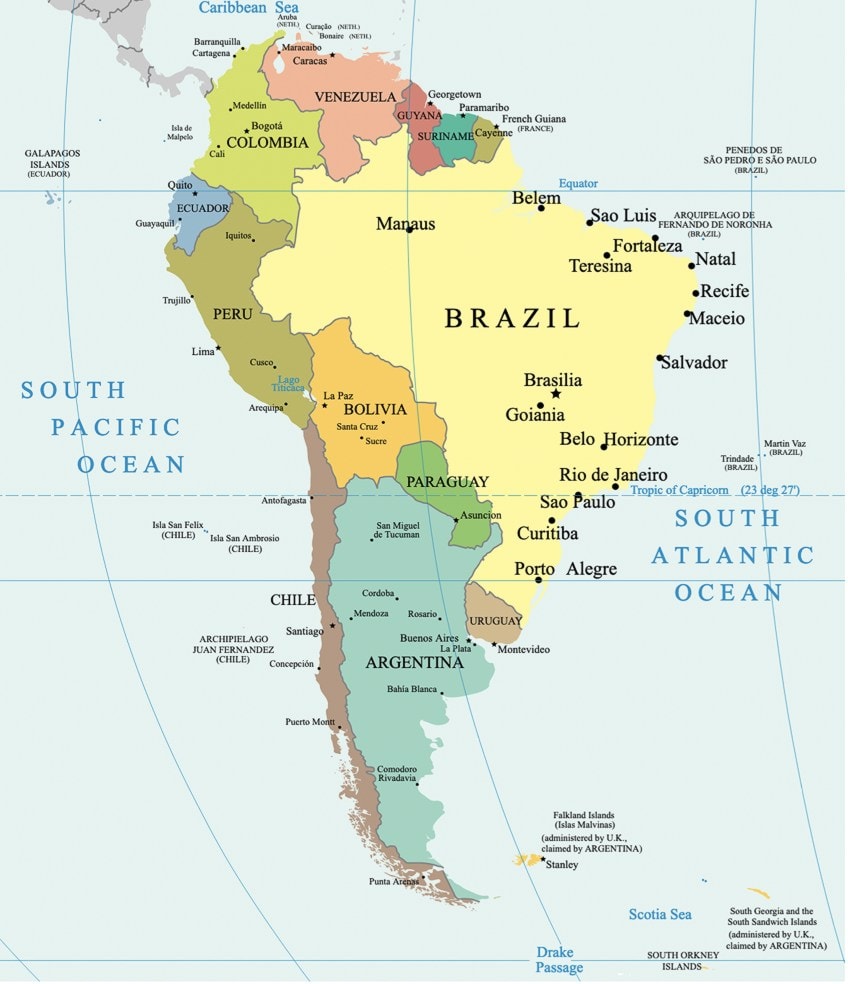 Political map of Due south America;High source, CC BY-SA 4.0, via Wikimedia Eatables
Latino art history has been closely tied to the deep-rooted history of the Americas. Furthermore, the Latin arts have had a shaky foundation and reception by society and are often overlooked and considered as peripheral or the "other", and perhaps mostly understood through diverse stereotypical perspectives.
Only this has changed equally America has been embracing its Latino roots even more than, and nosotros run across collections of Latin American painting exhibitions and displays throughout cultural institutions. At that place is an increased spotlight placed on the value inherent in Latin American art, and and so all the other branches, including South American art, which we will focus on more in this commodity.
The Colonization of the Americas
Firstly, what exactly exercise we mean when we speak about Latin arts or Latino fine art? For this, we need to look at history itself and where these terms originated. The term "Latin American" was supposedly first used equally a ways to distinguish some differences from the Americas with the people from North America, also referred to as the "Anglo-Saxons".
It is reported that it was used during 1862 when Emperor Napoleon Iii invaded Mexico.
Apparently, the Mexicans and French realized their languages were not very different from each other. The flow of colonization, which was from 1492 to 1810, was thought to exist one of the master shapers of the Latino civilisation. Latin America was conquered by Spain and Portugal, as well as the French Empire.
Latin Art
Latin American fine art is various and cannot all be placed within the same categorizations or considered a singular form of Latin Art. From each region, nosotros find unlike genres, modalities, and styles of Latino art, and these all tell a unique and dissimilar story on their own. Beneath, nosotros await at various examples by South American artists, from the early 20th century to more contemporary times.
At that place have been different styles or movements through Latin art history and one of the prominent exhibitions worth mentioning has been by the Museum of Modern Art (MOMA). The exhibition started on June vi and lasted until September vii in 1993, and was called Latin American Artists of the Twentieth Century.
 Museum of Modern Art, New York;Elisa.rolle, CC By-SA four.0, via Wikimedia Commons
It gave an impressive and significantly educational overview of Latin art, starting from the early 1900s to the more than contemporary periods. It had over 300 artworks on the display of artists from all walks of life and media, for example, painting, drawing, sculpture, and various installations besides as others like photography.
The art movements covered from this exhibition were, namely, Early Modernism, Expressionism and Landscape Painting, Mexican Painting and Social Realism, Surrealism and Lyric Abstraction, Geometric Abstraction, and Kinetic Art, New Figuration, Pop Art, and Assemblage, and Recent Painting and Sculpture.
All these movements play a key part in the shaping of Latin arts and its diverseness.
Muralism has also been ane of the primary and most common forms of Latin artwork. Peculiarly Mexican Muralism, which started around the 1920s. The purposes were to face and unify Mexico, this was after the Mexican Revolution. Murals had a socio-political meaning. The principal artists associated with this movement were, namely, José Clemente Orozco, Diego Rivera, and David Alfaro Siqueiros.
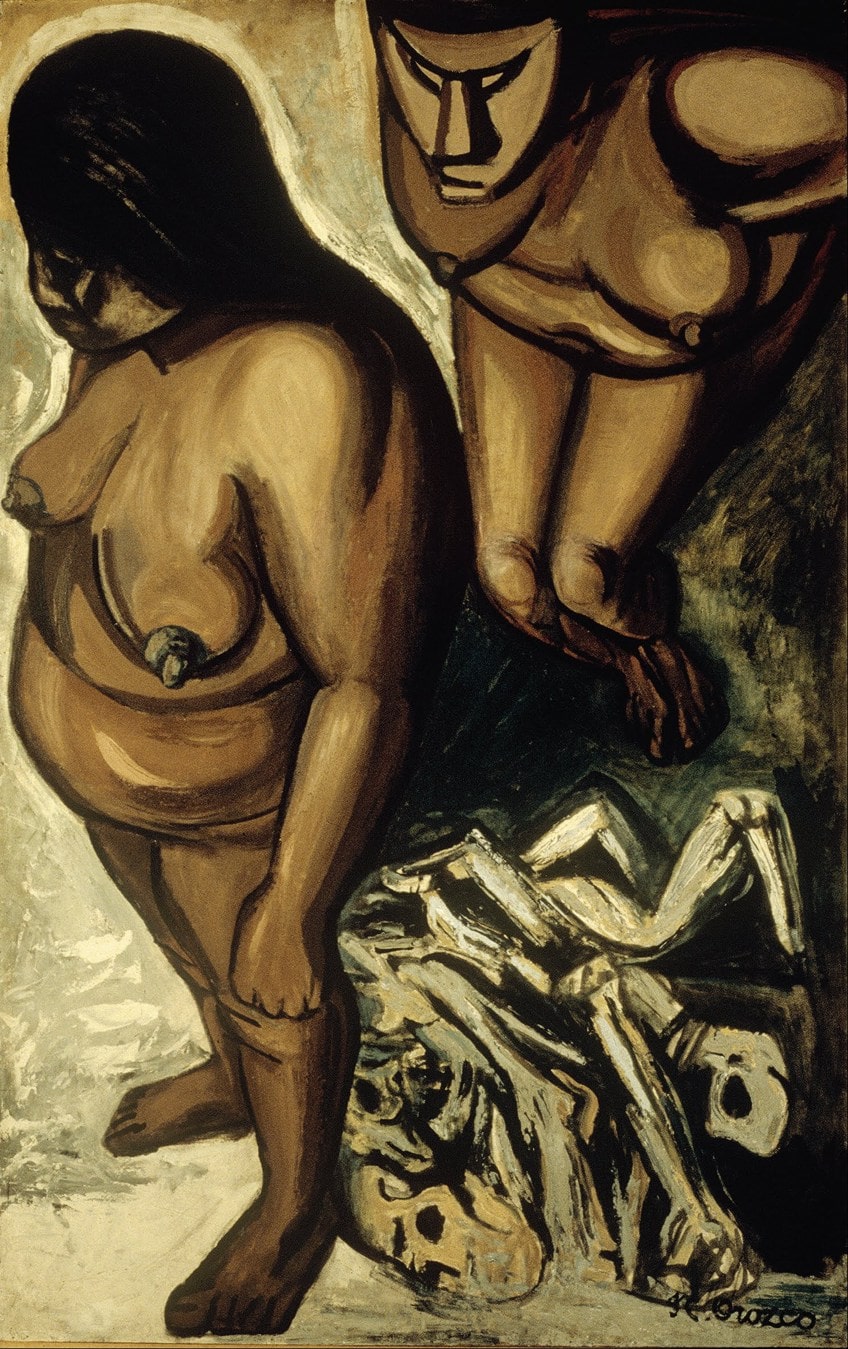 Indian Women, from the Los Teules series (1947) by José Clemente Orozco; Museo Nacional de Arte, Public domain, via Wikimedia Commons
Surrealism was also an influential art motion, and one of the famous artists we know today is Frida Kahlo, she was considered a Surrealist and Magic Realist. She painted images conveying the pain she experienced equally a woman every bit well equally giving other women permission to express themselves. She has been a leading figure in Latino art history and is worth mentioning besides.
To provide a Latin American painting example, some of Kahlo's artworks include her famous Self-Portrait on the Deadline Between Mexico and the United States (1932), The Two Fridas (1939), Cocky-Portrait with Thorn Necklace and Hummingbird (1940), and Wounded Deer (1946).
S American Art
Beneath nosotros look at South American art, specifically, we volition look at pre-Columbian examples, which were before the 1500s and subsequently the 1500s when Columbus colonized the Americas. Andean art primarily includes pre-Columbian Due south American art.
Some Pre-Columbian Examples
It was characterized by its wide range of modalities, including textiles, ceramics, as well as state fine art. There was a close connexion between nature and fine art and the 2 were interconnected, in other words, art was also functional. Some examples include The Paracas Textile (100 to 300 C.E.), which is from Republic of peru along the S Coast.
Information technology was believed to exist a head wrapping for the buried. It depicts various figures, believed to be shamans, property severed heads. They also have wings, which are believed to comport them to another world, possibly the afterlife?
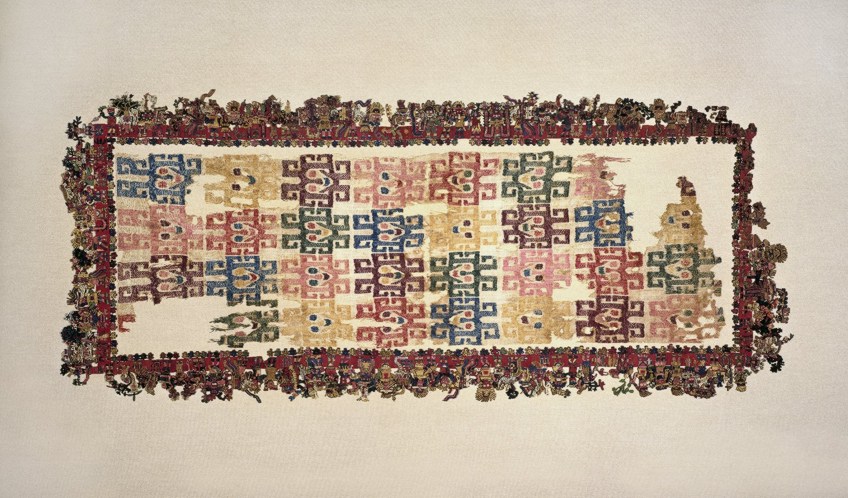 The Paracas Textile, 100-300 C.E.;Nasca Culture, Republic of peru, No restrictions, via Wikimedia Commons
Other South American art examples include the magnificent land art called the Nazca Lines or Nazca Desert Geoglyphs, particularly the formation chosen Hummingbird (c. 4th century B.C.). Although at that place were numerous other formations in the shape of animals like spiders, monkeys, and sea mammals like killer whales.
Hummingbird is in Peru on the South Coast is 300 feet long and constructed from various materials like rock. It is believed it was fabricated by groups of people. The meaning of these massive structures is still debated. Some believe they were for deities because they tin only be seen in their whole from in a higher place, an aerial view.
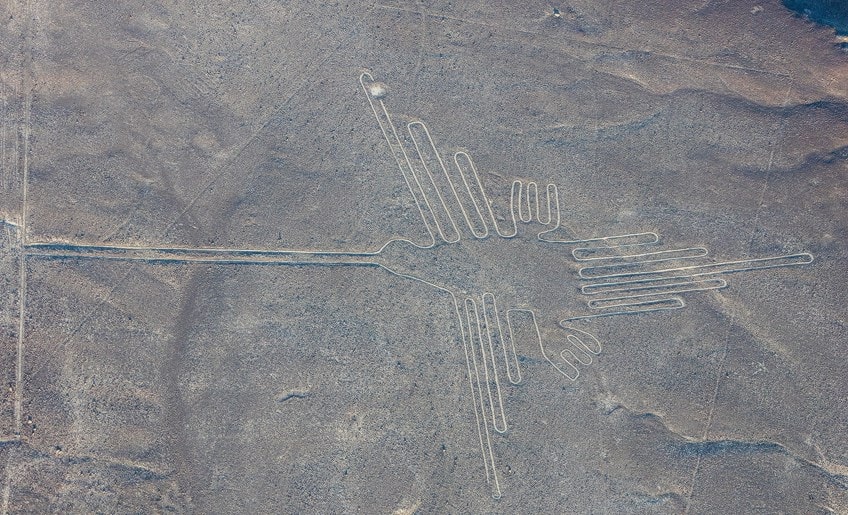 Hummingbird geoglyph aerial in the Nazca Desert, Peru;Diego Delso, CC Past-SA four.0, via Wikimedia Commons
Other meanings might point to these structures used for people to walk them, like pilgrimages, and utilized these structures for more than collective celebrations and ritual-based gatherings. Still, other ideas propose that the structures were intended for farming purposes and the fertility of crops. Other formations related to h2o could have been for crops to grow.
Additionally, these formations too pointed towards the mountainous areas where the gods resided, according to mythology. Once again, these structures could take been to venerate deities.
Amongst South American art lies keen architectural structures, for example, the Inka citadel called Machu Picchu (c. 1450 to 1540). It was constructed for Emperor Pachacuti Inka Yupanqui who would stay there during a select time of the year.
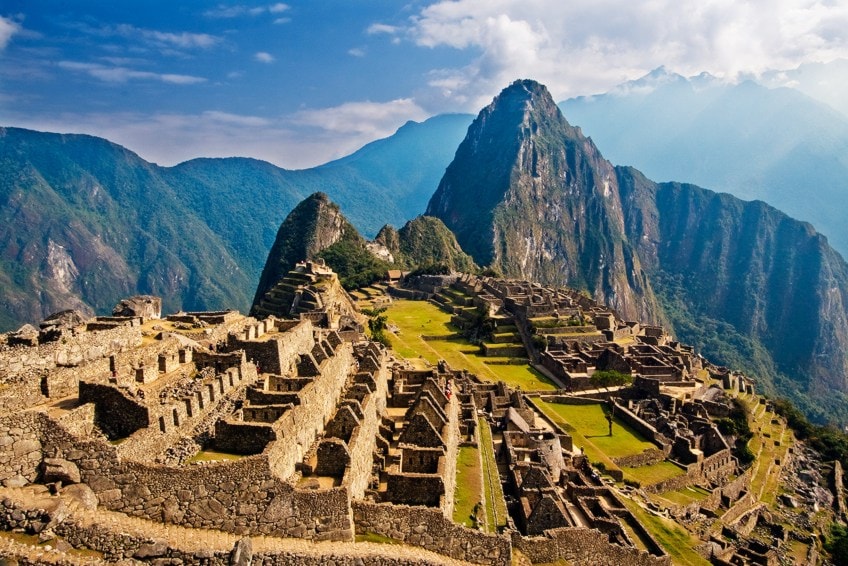 Machu Picchu;Pedro Szekely at https://www.flickr.com/photos/pedrosz/, CC BY-SA 2.0, via Wikimedia Commons
This was built as a mount home, so to say, with upper and lower sections all with their own functions. It was able to accommodate not but the Inka Emperor and his family, but other housing, warehouses, areas for assistants, various religious areas, terraced areas, and more.
The structure was made from stones prepare next to the other, and these were also polished dry-rock walls.
The stones were reportedly made past existence individually constructed to fit in adjacent to the other. The stones that were polished appeared almost mosaic-like, this was on the outer walls, and undoubtedly would have added an aesthetic appeal.
There are 3 main religious structures at Machu Picchu, namely, The Temple of the Sun, which is as well known as the Observatory. This structure was built to track constellations and solstices, more specifically the June solstice.
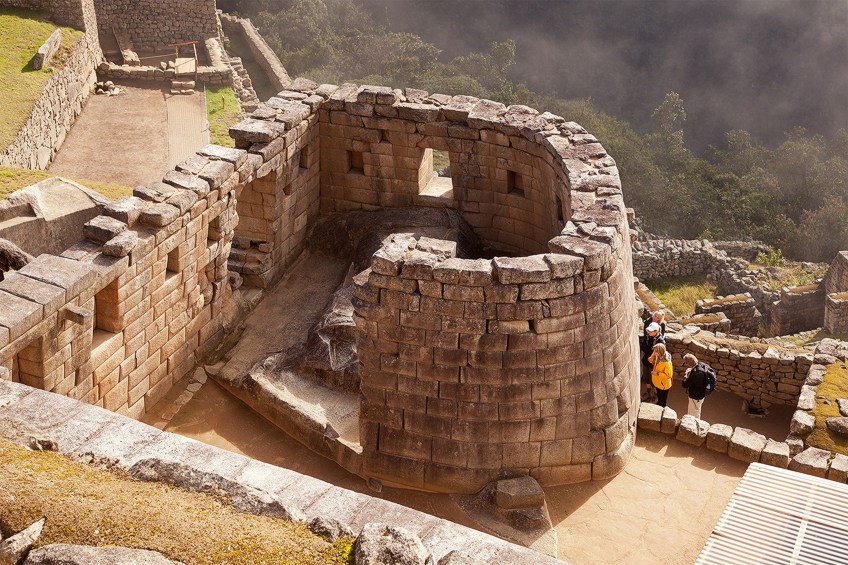 Machu Picchu, Lord's day Temple;Unukorno, CC Past iii.0, via Wikimedia Eatables
The Intihuatana stone is another religious structure, which ways "hitching post of the lord's day". It was made to trace the pathway of the sun across the sky throughout the yr and during the Winter solstice it lines upwards with the sun. The Inka civilisation constructed numerous stones such as this ane to rails the sun.
Machu Picchu was only in active utilize for around fourscore years and then abased due to Spanish invasions and conquests that threatened the livelihood of staying there. Information technology has been a UNESCO World Heritage Site since 1983.
Information technology has also been considered as one of the New Wonders of the World since 2007.
Columbian and Post-Columbian South American Art
It is important to note that Latin American history is complex and various, and this implicates how art was produced also. There are a vast number of different types of fine art created nether hundreds of dissimilar circumstances. Therefore, we will look at a few examples of colonial, mail service-independence, and contemporary South American fine art.
Colonial Art
During the colonial period in South America, when Christopher Columbus founded the Americas in 1492, at that place were complex new systems and power structures at play. Information technology was not just Christopher Columbus who founded the Americas, only the Portuguese also happened upon Brazil during the 1500s.
This was the Portuguese navigator Pedro Alvares Cabral who unintentionally plant Brazil while he was trying to undertake the same route as the Portuguese Vasco da Gama, who sailed from Portugal to India in 1498 to create merchandise routes between the unlike continents, namely, Europe and Asia.
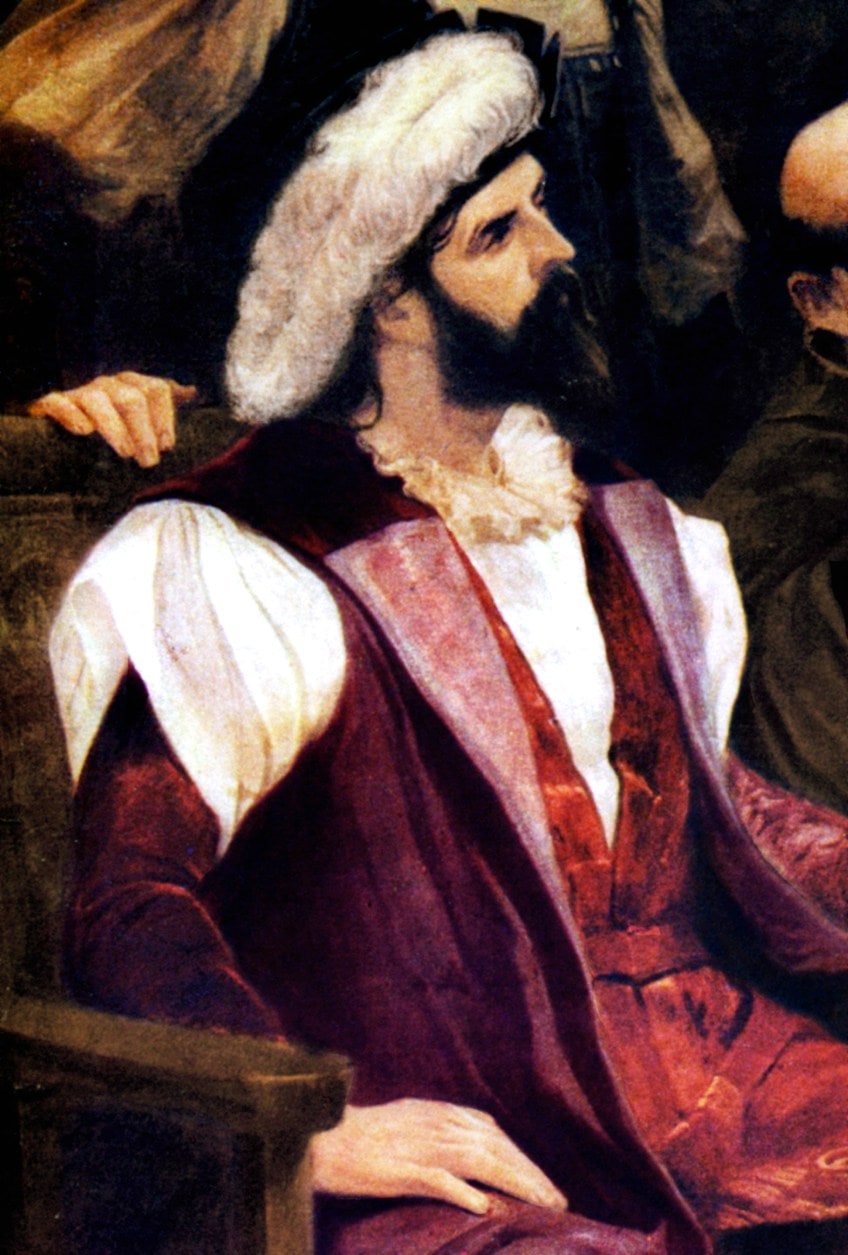 Detail of painting Vaz de Caminha reads to Commander Cabral, Friar Henrique and Main João the letter that volition be sent to King Dom Manuel I (1900). It depicts Pedro Álvares Cabral, leader of the Portuguese expedition that discovered the land that would later exist known as Brazil in 1500;Francisco Aurélio de Figueiredo e Melo (1854–1916), Public domain, via Wikimedia Eatables
One of the master attractions in Brazil was sugarcane farming; the Dutch also attempted to colonize Brazil, which was during the 1630s to 1650s. There were various Dutch artists who were commissioned to document Brazil's natural surround too as the Brazilian culture. One of these artists included a well-known artist during this fourth dimension was Albert Eckhout (c. 1610 to 1665) who created South American art but from the European perspective.
Of Eckhout's artwork is his series of eight figures who are representative of the unlike cultures he witnessed while painting in Brazil. The figures consist of four males and 4 females each standing in a pose reminiscent of European standards for how fine art was made.
Equally some sources suggest each person posed for the purpose of representing an indigenous grouping and non so much as an private portrait, a blend of scientific discipline and art, too as an almost stereotypical approach to other cultures, which opens the debate of the concept of the "Other" and how it has been represented in art, especially by Europeans.
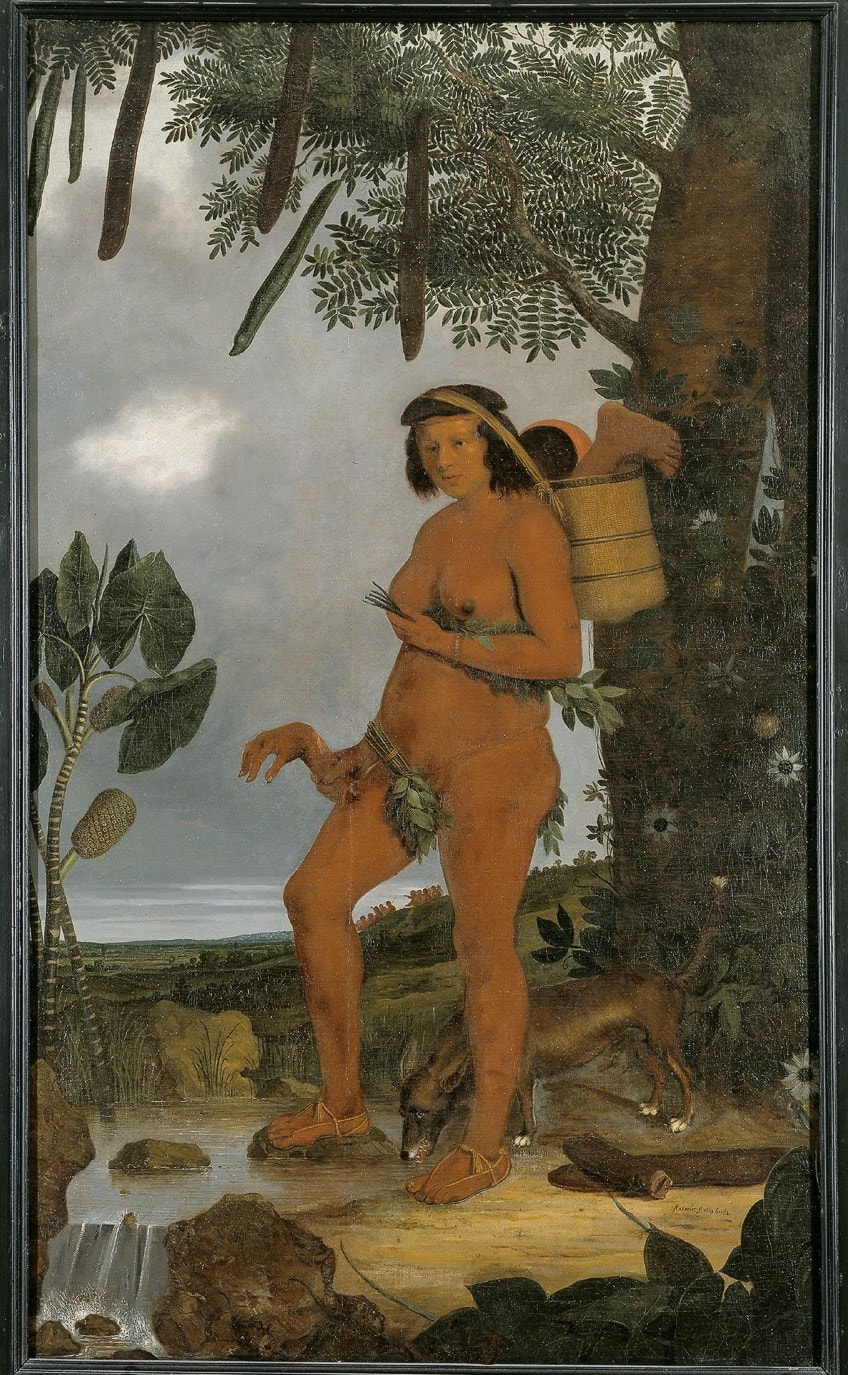 Tapuya Adult female (1641) by Albert Eckhout;Nationalmuseet, Public domain, via Wikimedia Commons
In the eight paintings, nosotros see the male and female pairs from the Tapuyas, namely, the Tapuya Woman (1641) and the Tapuya Man (1641). And then there is the African pair, namely, the African Woman (1641) and the African Man (1641). The Brazilian pair, named similarly, the Brazilian Adult female (1641) and the Brazilian Man (1641). Lastly, the Mameluca Woman (1641) and the Mulatto Man (1641).
Each effigy is painted with culturally characteristic objects around them, including the landscapes and environments in the background.
For case, we encounter the Tapuya tribe woman carrying severed limbs, which alludes to them equally cannibals and one of the tribes that fought against the Europeans. The Brazilian tribe is depicted equally more than "civilized" with the background landscape actualization more than structured compared to the jungle-similar setting of the Tapuyas. Furthermore, the Brazilians are clothed in neat white cloths covering their genitals, whereas the Tapuyas appear completely naked, their genitals sparsely covered with makeshift leafage.
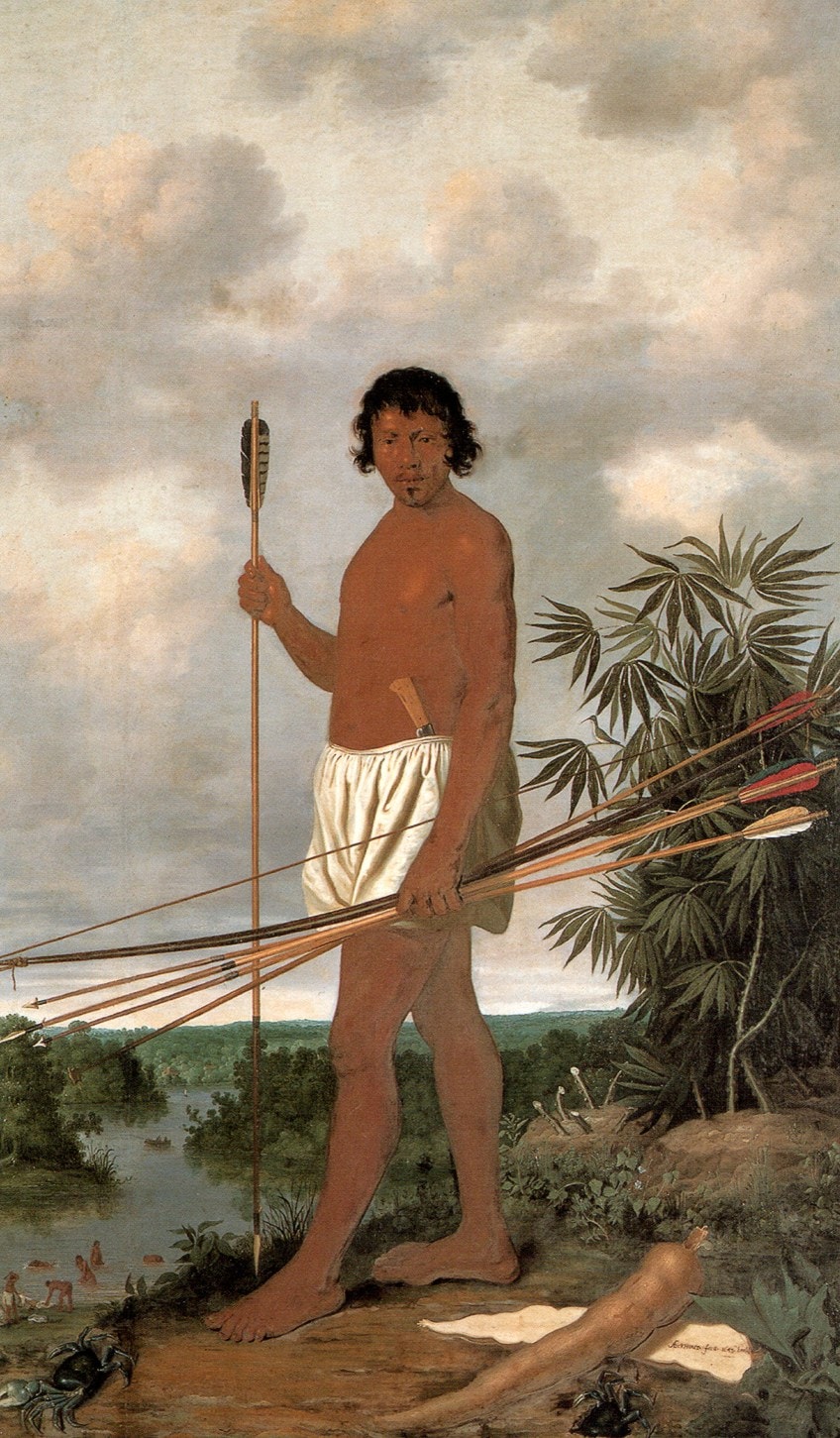 Brazilian Man (1641) past Albert Eckhout;Albert Eckhout, Public domain, via Wikimedia Commons
The African couple is both depicted as strong figures, alluding to the notion of Africans being strong and used equally slaves for this reason. We see cantankerous-cultural objects in the woman's painting, namely, the jewelry and pipe, which originates from Europe, the basket and hat originates from Africa, and the landscape with figures in the distance is Brazilian. The male figure is depicted in most probably North Africa and surrounded by items that were traded during that time, namely, the ivory tusk on the basis in the lesser correct foreground and the date palm just behind the figure.
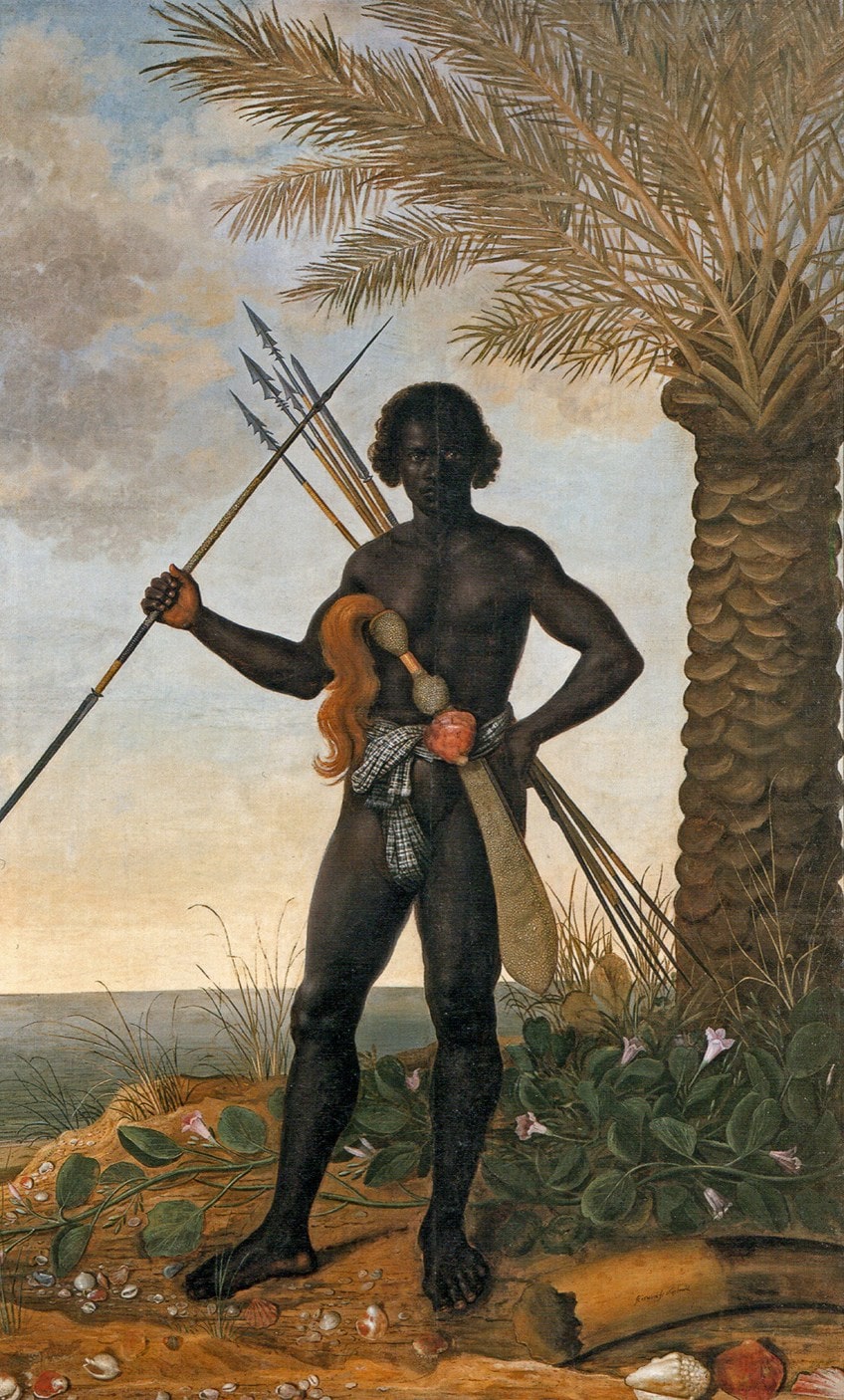 African Man (1641) by Albert Eckhout; Albert Eckhout, Public domain, via Wikimedia Commons
Lastly, the Mameluca Woman (1641) and the Mulatto Man (1641) advise people who are mixed race. The adult female shares indigenous and European ancestry and the male person shares European and African beginnings. The stances for each are different and suggestive of their ethnicity. The woman wears a long white robe or dresses with her left leg (our correct) slightly exposed to betoken her sexuality and desirability as a concubine. The human being is depicted every bit continuing on guard with the groundwork depicting a sugarcane field. He wears clothing reminiscent of European and other cultures – a scrap of both of these two worlds, so to say.
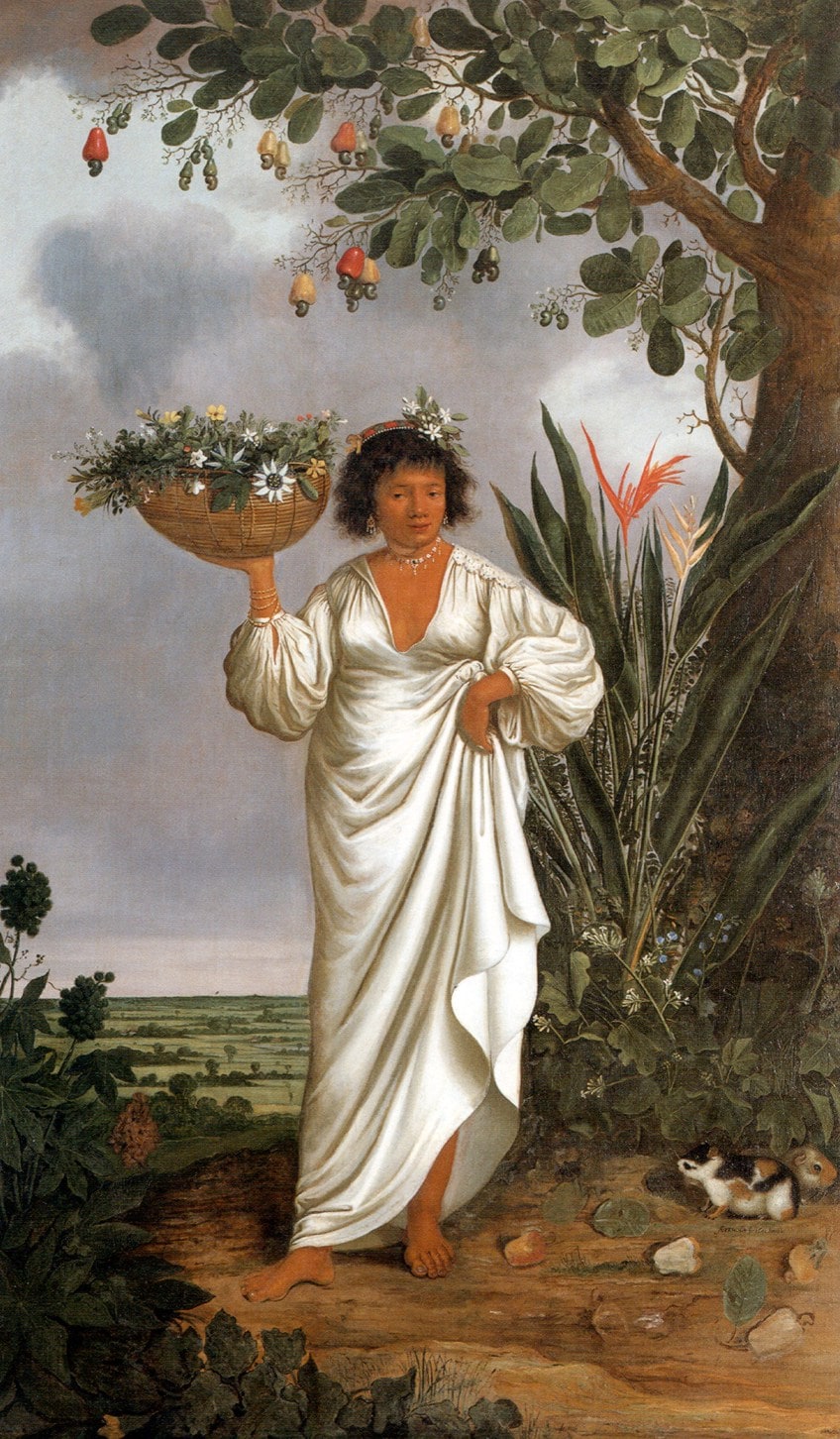 Mameluca Woman (1641) by Albert Eckhout; Albert Eckhout, Public domain, via Wikimedia Commons
Postal service-Independence
If we look at an example from the post-Independence period of South America, and Latin America, which was around the later function of the 18th century and earlier 19th century we will find many examples of art that depicted the idea of independence and the battles related to it; art depicted heroic figures and the notion of liberation.
Some of the prominent art genres included Portraiture and History painting.
Pedro José Figueroa (1770 to 1838) was a Colombian painter who specialized in portraits. However, Figueroa'southward lineage included other artists who besides painted portraits as well as miniatures. What was interesting about Figueroa's painting was his focus on figures that were accounted of import in terms of liberation and military prowess.
1 such figure Figueroa painted often was the Venezuelan Simón Bolívar. He was ane of the major political and military figures who liberated non simply Venezuela, simply other S American countries like Peru, Ecuador, Colombia, Bolivia, and Panama from the conquest of the Spanish Empire during the 1800s. He is known by the proper noun El Libertador and Liberator of America.
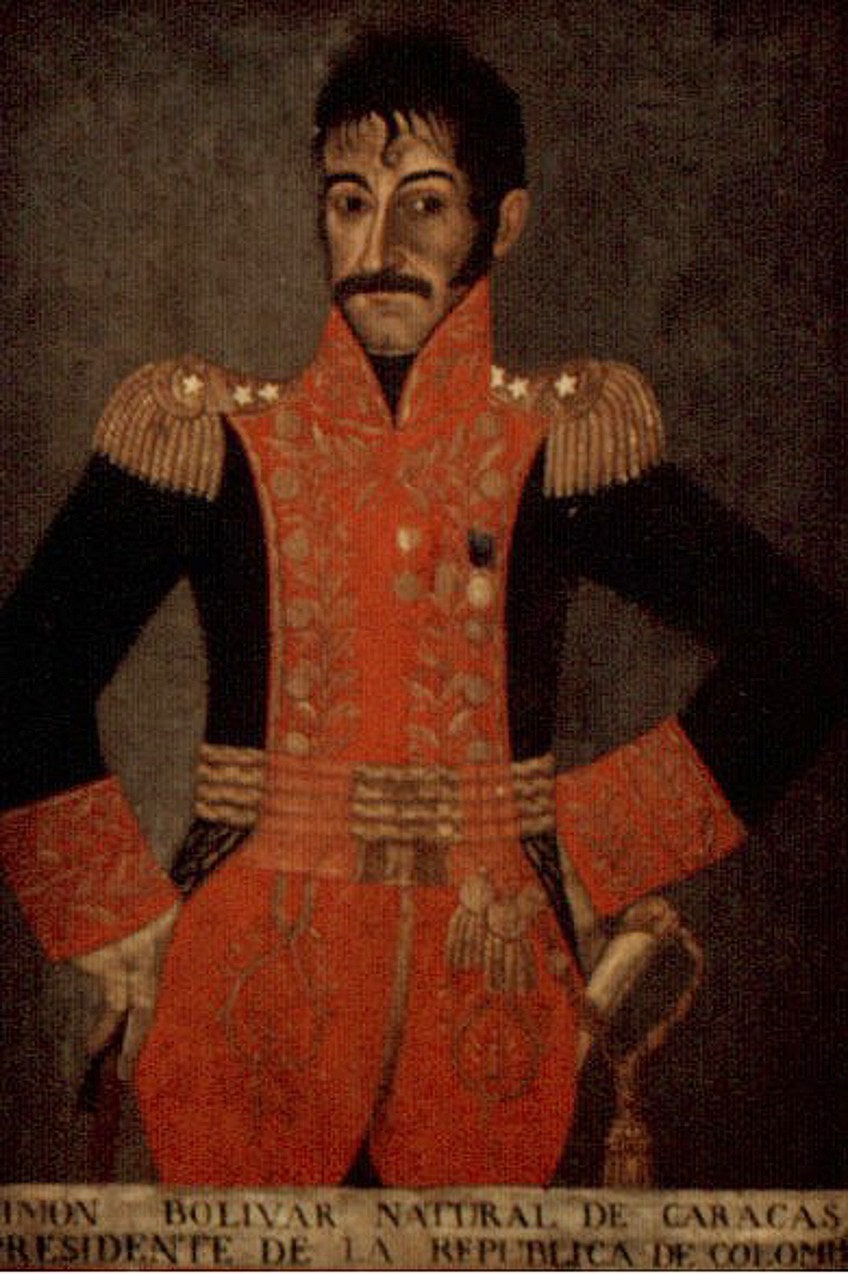 Portrait of Simón Bolívar (c. 1810) by Pedro José Figueroa; Colombian National Museum, Public domain, via Wikimedia Commons
Examples of paintings include Figueroa'southward oil on sheet Bolívar and the Allegory of America (1819) and Simón Bolívar: Liberator of Republic of colombia (c. 1820). The heroic figure is depicted in a frontal pose with a trunk posture that appears potent and upright. In both paintings above he wears his military compatible seemingly proudly with golden stars, epaulets, belt buckles, and his sword against his left hip (our right).
We will also discover words as role of the painting, which were utilized frequently in colonial artwork to emphasize the figure's importance. Furthermore, in Bolívar and the Allegory of America, we run into El Libertador standing next to the smaller effigy of a woman, his right arm around her shoulders. She is holding a bow in her left paw with a set of arrows slung on her back. She appears disproportionate in size compared to him.
If we expect at History painting, which was an important genre during this time, information technology depicts scenes of battles and important events.
José María Espinosa was a Colombian artist who depicted various historical moments from the Battle of Palo River. All the same, sources also point out that his painting Battle of Palo River (c. 1850) is more of a Landscape genre painting because of the creative person's focus on the environment and non so much the boxing or figures pertinent to it.
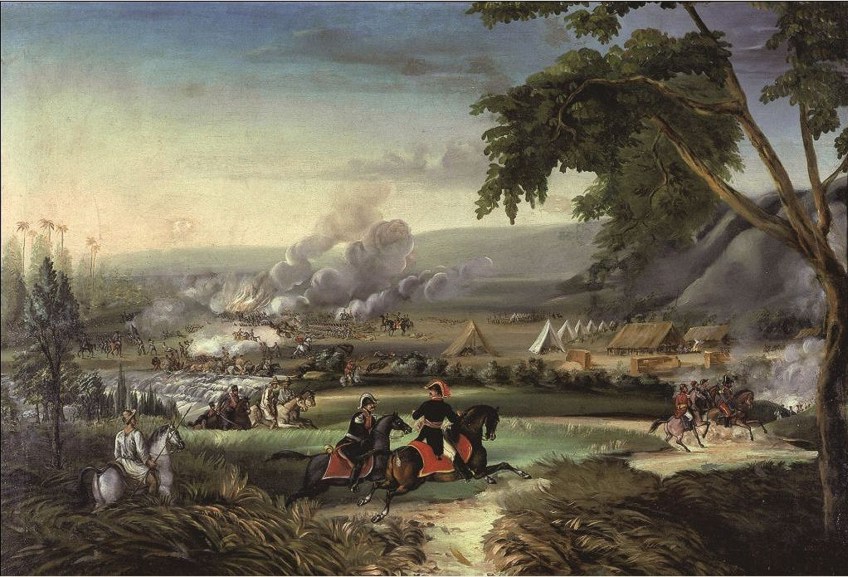 Battle of Palo River (c. 1850) by José María Espinosa; José María Espinosa Prieto, Public domain, via Wikimedia Commons
Regardless of Spinosa'south genre, this painting is skillfully composed and depicts a vast mural with a hazy setting sun in the far distance, billowing smoke about the left side in the middle basis, and two soldiers who appear in deep discussion with ane another while riding their galloping horses towards the correct side where nosotros meet a group of more soldiers straddling their horses. There is a sense of urgency in this scene and an ironic beauty of the environs surrounding the battle.
Gimmicky Due south American Art and Artists
Below we talk over artists from the earlier 1900s to the more than contemporary times equally South American art has developed exponentially in so many modalities and media. While in that location are hundreds of talented South American artists, nosotros urge you to explore them farther beyond the artists we mention below.
The Brazilian Tarsila do Amaral (1886 to 1973) was amongst the pioneers of Latin American art during modernism.
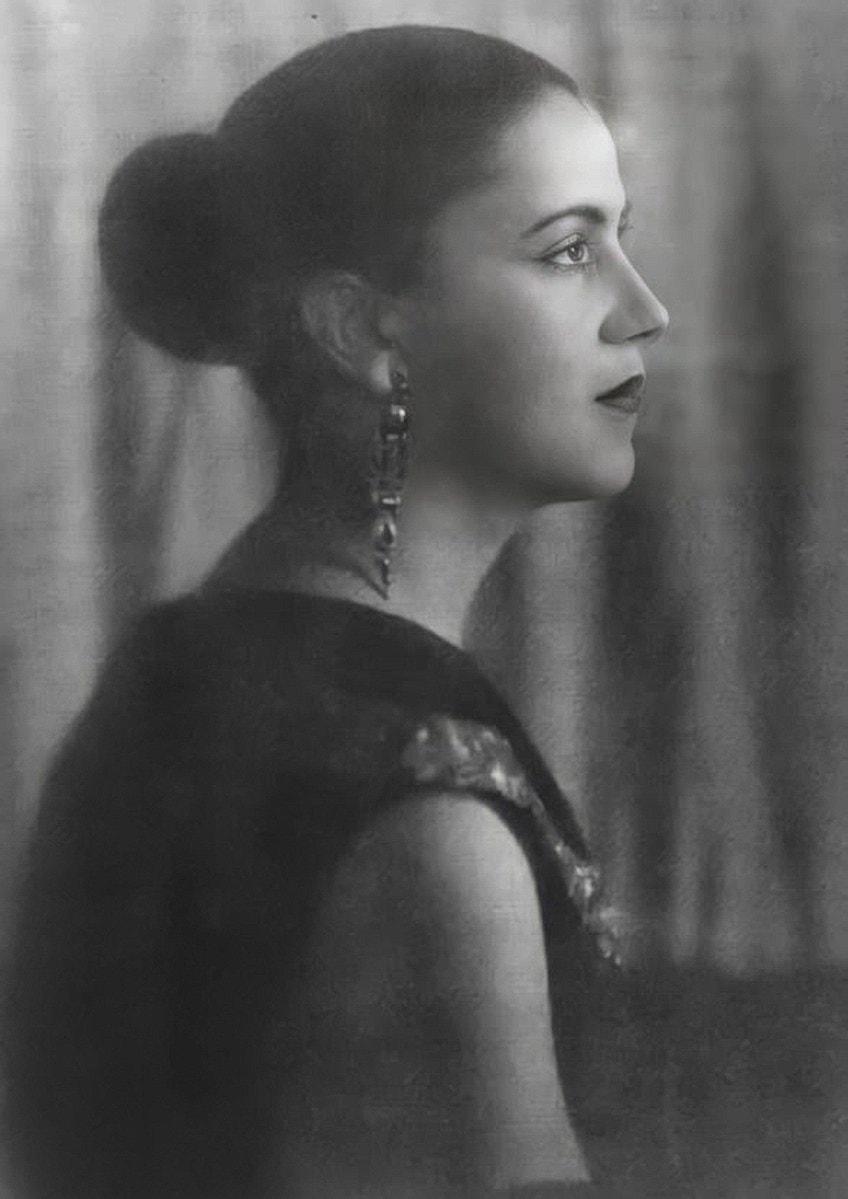 Portrait of Tarsila do Amaral, c. 1925;Unknown authorUnknown writer, Public domain, via Wikimedia Commons
She was multi-talented every bit a translator, painter, and draughtswoman. She was part of the Brazilian Modernism group called Grupo dos Cinco meaning "Group of Five", the artists of which explored the significant of beingness a Brazilian and touched on pertinent ideologies effectually identity, and paved the way for modernism in Brazil.
Furthermore, Amaral was also influenced by Surrealist art and later on a period in Paris, she returned to Brazil where she started producing a new fashion of art. Her famous Abaporu (1928) oil on canvas painting was done as a present for her husband Oswald de Andrade. Subsequently this painting, he wrote the Anthropophagite Manifesto, which also developed into the motion called Anthropophagic Movement.
This manifesto and movement sought to "eat" European styles. Information technology was intended to inspire Brazilian artists to let go of the need to emulate European fine art and to embrace their Brazilian identities.
If nosotros await at Abaporu, information technology depicts a nude man sitting on a patch of green grass, there is a light-green cactus to the right, and a bright yellow dominicus shining in the blueish sky higher up. The sky makes up two-thirds of the background color with the grass effectually a third. This painting sounds quite simple; notwithstanding, the figure of the man is uniquely rendered. His arm and leg are disproportionately large in the foreground and equally we look up to his head it is minuscule in size as if nosotros are viewing him through a special sort of telescope.
Amaral has described her figure every bit a "monstrous solitary figure". Other examples by Tarsila practise Amaral include Antropofagia (1929), which depicts another feature enlarged figure, in the nude, sitting amongst a natural landscape of leaf and large cacti with a blazing background sun.
A Negra (1923) depicts a nude female figure sitting cross-legged with a geometric groundwork of nighttime blue, greenish, and red horizontal and diagonal bands. Hither we likewise see the voluptuous advent of the figure, her right breast (our left) hangs slightly over her correct forearm (our left) with her elbow resting on her right knee (our left).
Her head is disproportionately smaller than her body and her optics are very small compared to her full and larger lips. These are just some examples of the unique style from Amaral, a style she undoubtedly infused with her Brazilian identity and culture.
From the centre of the 1900s, the Colombian Fernando Botero (1932 to nowadays) grew into a well-known artist, he fifty-fifty had a named style, which was "Boterismo".
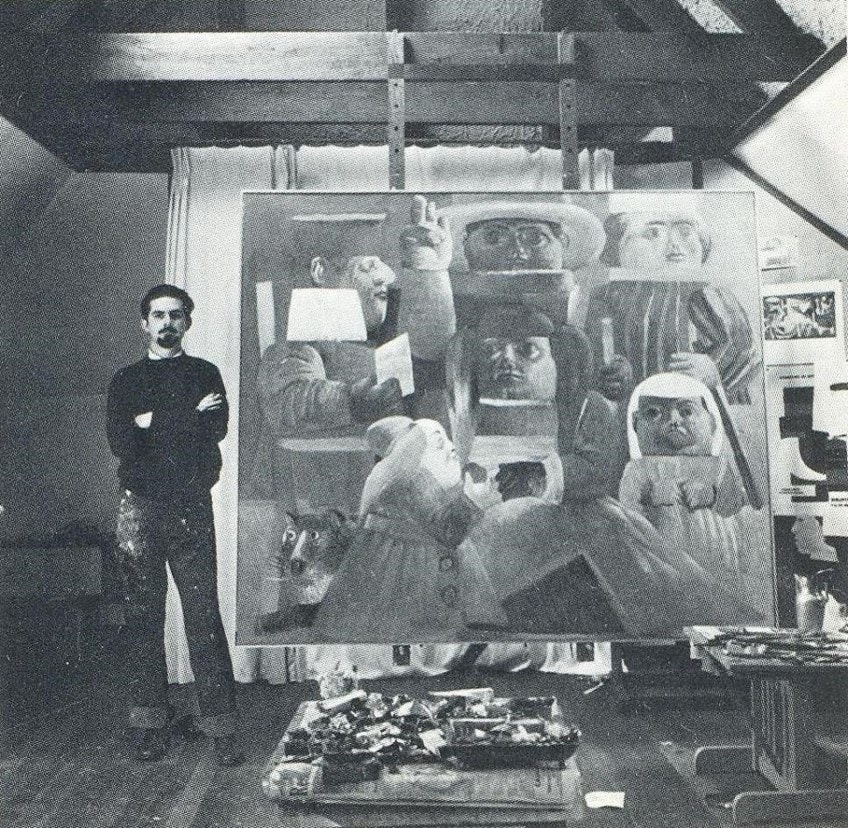 Fernando Botero, 1958; Dantelectrico, CC BY-SA 4.0, via Wikimedia Commons
Nosotros can easily identify this style past his enlarged, or as they were called "fat", and disproportionate figures. He ofttimes depicts them equally very relaxed and lounging with an chemical element of humor and as it has been described satire, nevertheless, there are too political and social undertones to his compositions.
Although he has traveled internationally and studied from the Renaissance art way, too studying fresco painting. Botero has chosen himself the "most Colombian artist living" because he does not seem interested in subscribing to artistic "trends" prevalent throughout the world.
Some of his artworks include Dancing in Colombia (1980), which depicts a café scene with seven over large musicians staring, quite blankly, directly at usa, the viewers. They appear to be playing their instruments but somehow seem at a stand-all the same. In front of the musician is an developed couple dancing and enjoying themselves on the dance floor. The couple is depicted considerably smaller in size and compared to the musicians appear out of proportion and almost childlike, which makes the painting even more unique and mysterious. We volition notice various cigarette buds and food lying on the floor and office of a jukebox to the left.
What is Botero communicating through this painting?
Some sources advise that this café could indirectly signal more than than what we run into, for example, who would the type of patrons that would frequent a café like this exist and what would happen upstairs if at that place were rooms to rent? Although Botero fills upwardly the limerick with his total figures, he leaves room for us to imagine what else might be happening beyond the dance floor.
We volition also find Botero's figures beyond the canvas equally numerous sculptures around the world. These range from voluptuous women, for example, Broadgate Venus (1989), soldiers similar Man on Horse (1992), animals like Cat (1990), and a equus caballus called Caballo con bridas (2009).
Eduardo Kobra (1975 to nowadays) is a young South American artist from São Paulo in Brazil. He is a street artist who began painting at the early age of 12 years old. He has created thousands of murals all effectually the world. He draws attending to social and political figures by bringing them to every member of order through his murals on buildings. Examples include Ethnic Groups (2016), which was one of his largest murals for the Olympic Games, and Mother Teresa & Gandhi (2018).
Leo Chiachio (1969 to present) and Daniel Giannone (1964) upends gender stereotypes inherent in craft and material fine art. As a gay couple, both from Argentina, they create hand-embroidered and fabric mosaics that explore various traditional and modern stereotypes and social ideas.
They have held numerous collective and solo exhibitions of their works and accept likewise been trained as painters.
The artistic duo describes their works as "painting made with threads" and focuses on themes around family and the diversity inherent in family structures. We volition see this recurring theme depicting the couple and their dog in some examples like Nacimiento (2010), La Familia en la Fontana di Trevi (2011), Piolin Boogie Woogie (2012), and Calaverita (2014) among many others.
Celebrating Latin America
Latin America has stood the tests of time considering it has been through numerous conquests and colonial battles. The essence of power, independence, and liberation lies at the heart of Latin American art, whether information technology is from the early 19th, 20th, or 21st centuries. Information technology is a civilisation at present filled with diversity and the joy to express national identity and pride. Furthermore, Latin America has been perceived in stereotypical means for years, and artists have been amongst those addressing these stereotypes and ideologies, putting the correct cultural pieces dorsum into identify.
This article explored a facet of Latin American fine art, seen from the vantage indicate of Southward American art. We briefly looked at information technology from the pre-Columbian era when art was not soiled by the metaphorical blood of battles from the colonial rule of European powers. Nosotros and then looked at a few examples of colonial fine art and how dissimilar its motives were compared to the postal service-Independence artworks from the modern era. All the above has shown us that not simply South American art, but the Latin arts, in full general, is complex and diverse and worthy of being showcased and celebrated in all its glory, fifty-fifty if it is non always understood past the balance of the globe.
Frequently Asked Questions
What Is South American Art?
Due south American art is part of Latin American art. Latin America is a collective term including the areas of South America, Central America, too every bit countries from the Caribbean. The countries' languages share the same origins from the Latin linguistic communication for example French, Spanish, and Portuguese. S America comprises Argentine republic, Republic of bolivia, Brazil, Republic of chile, Colombia, Ecuador, Guyana, Paraguay, Republic of peru, Suriname, Uruguay, Venezuela, and other areas.
How Old Is Southward American Art?
South American art goes as far back equally aboriginal times to the Andean cultures, for instance, who built famous sites like Machu Picchu. Information technology has a rich pre-Columbian and colonial history and artworks that explore these social and political periods. The post-Independence period express a different type of South American art, filled with freedom and freedom, we volition see the wide variety in hundreds of Modern and Contemporary Southward American and Latin artworks. Therefore, the timeline for South American art goes far back and is ever-expanding into the present and the future.
What Influenced Latin American Fine art?
Latin American art is various with different genres, modalities, and styles. It has been influenced by many other cultures, for instance, France, Portuguese, Castilian, and Dutch. Modern and contemporary artists have also been influenced by European styles like the Renaissance, for example, still, some artists still maintain and stay grounded in the national identity and the Latin culture.
Source: https://artincontext.org/south-american-art/
0 Response to "Cool South America Things to Draw"
إرسال تعليق